Post 7/10 — reflections on scientific writing, clarity, and communication
One aspect of writing that I have come to appreciate is creating flow between paragraphs.
Even when individual sentences are clear and well-constructed, a text can still feel disjointed. The ideas may be correct, but the overall reading experience lacks continuity.
Over time, I have found it helpful to think of each paragraph as consisting of three parts.
First, a core sentence that expresses the main idea of the paragraph providing context before content.
Second, supporting content that develops or explains this idea.
Third, a linking sentence that connects the current paragraph to the next one.
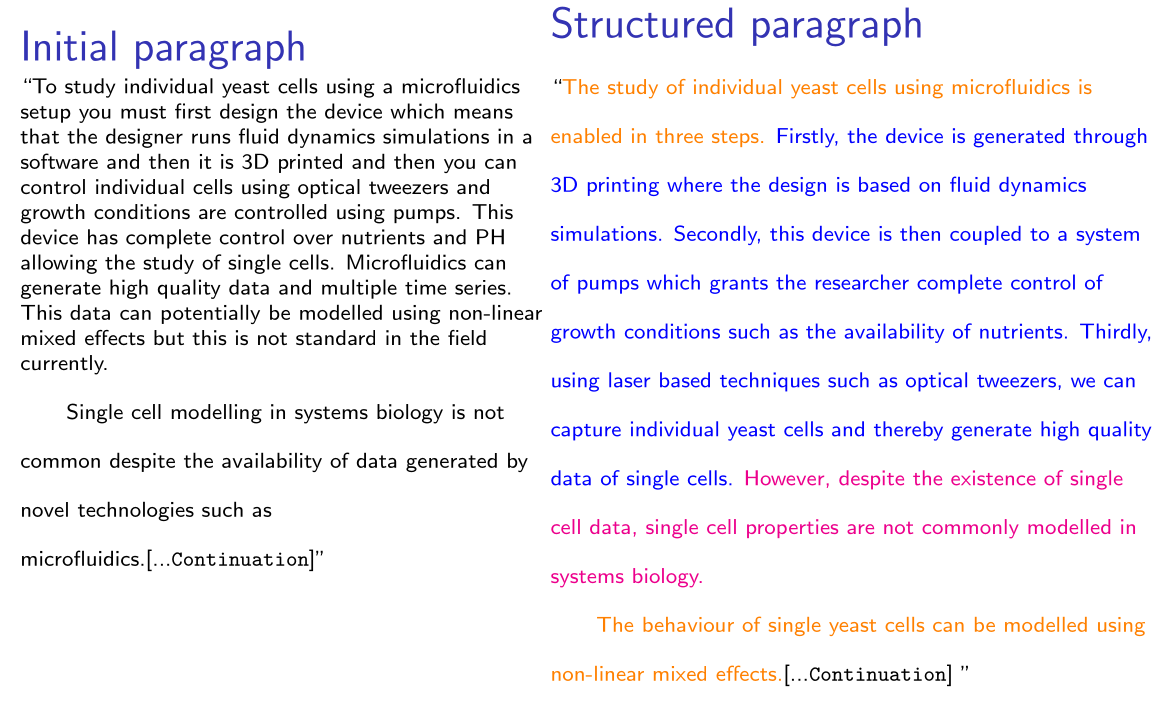
The first two parts are relatively intuitive and are often present in most writing. The third part, however, is easy to overlook.
In my own writing, I have often found myself finishing a paragraph and then starting a new one without explicitly connecting the two. As a result, the text can feel fragmented, even if each paragraph works well on its own.
By adding a linking sentence at the end of a paragraph, it becomes possible to guide the reader forward. This sentence does not need to be elaborate. It can simply indicate what is coming next or how the next idea relates to the current one.
When this is done consistently, the text begins to feel more cohesive. The paragraphs are no longer isolated units, but parts of a connected sequence of ideas.
As with the previous reflections, this is not a strict rule, but a simple technique that I have found helpful when trying to improve the flow of a text.
 Johannes G. Borgqvist, PhD
Leave a comment