Post 5/10 — reflections on scientific writing, clarity, and communication
When I struggle with writing a scientific article, it is usually not because of the details.
More often, it is because I do not yet see the overall structure of the paper — or, in simpler terms, the story I am trying to tell.
Over time, I have found it helpful to think of a scientific article as having a simple, underlying structure consisting of three parts: the introduction, the body, and the discussion.
The introduction provides context and gradually narrows down to a specific question.
The body presents the methods and results that address this question.
The discussion then takes a step back and places these results in a broader context.
In this sense, the structure can be thought of as a movement:
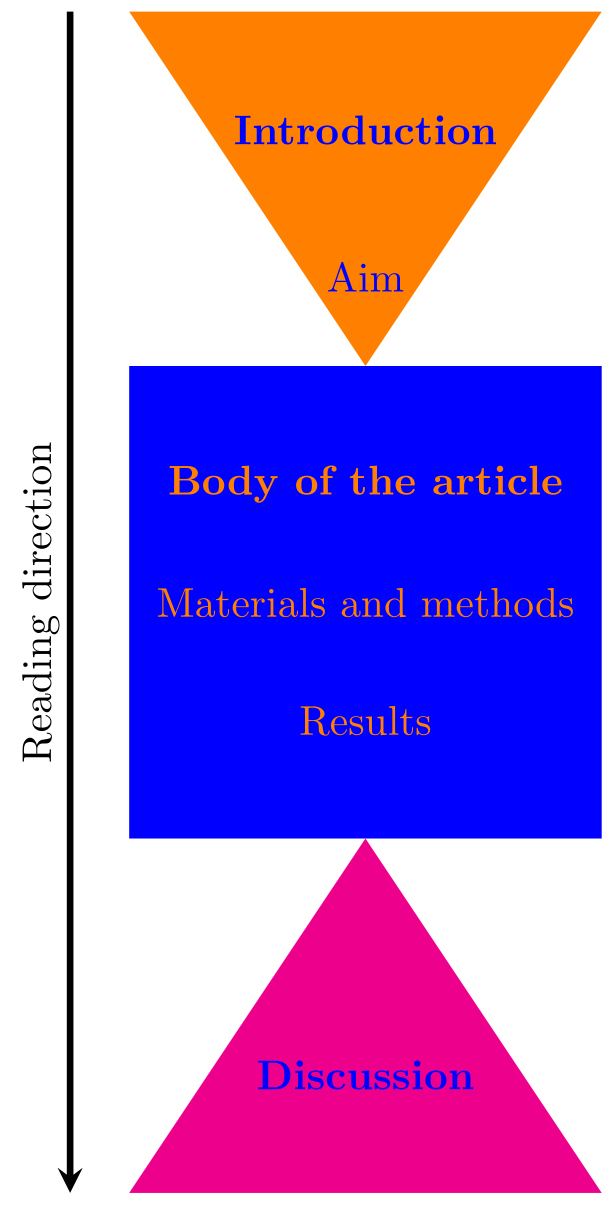
Start broad → focus → then zoom out again.
When this structure is clear in my mind, writing tends to become much easier. Each part has a purpose, and it becomes more straightforward to decide what belongs where.
However, one thing that has helped me is to realise that this structure does not necessarily have to be written in chronological order.
In practice, I often find it easier to begin with the results.
A useful first step is to lay out the results and try to organise them in a logical way. This is essentially where the story begins to emerge. Once the results are structured, it becomes easier to see what the paper is actually about.
From there, I try to give each part a clear and active title — something that captures what is being shown, rather than using more generic labels such as “Model” or “Plot”. A simple way to think about this is to phrase titles in terms of a relationship, for example: “A through B gives C”.
Once this structure is in place, writing the text itself becomes more manageable. In many cases, I will write the body first, followed by the discussion, and only then return to the introduction.
At first, this felt counterintuitive. However, it reflects the way understanding develops: the introduction becomes much easier to write once it is clear what the paper is actually saying.
In situations where I get stuck, I have found it helpful to pause and return to a simple question:
What is the story I am trying to tell?
This question shifts the focus away from individual sentences and towards the overall flow of ideas. Once the story becomes clearer, the writing often follows more naturally.
As before, this is not a strict rule, but simply a way of thinking about writing that I have found helpful in my own work.
 Johannes G. Borgqvist, PhD
Leave a comment