Post 4/10 — reflections on scientific writing, clarity, and communication
One of the simplest ideas that has helped me improve my writing is the principle:
Context before content.
At first glance, this idea seems almost trivial. However, I have realised how often I do the opposite in practice.
When writing, it is very tempting to move directly into details — results, definitions, or technical explanations — without first explaining why they matter. As a writer, this feels efficient. But as a reader, it often has the opposite effect.
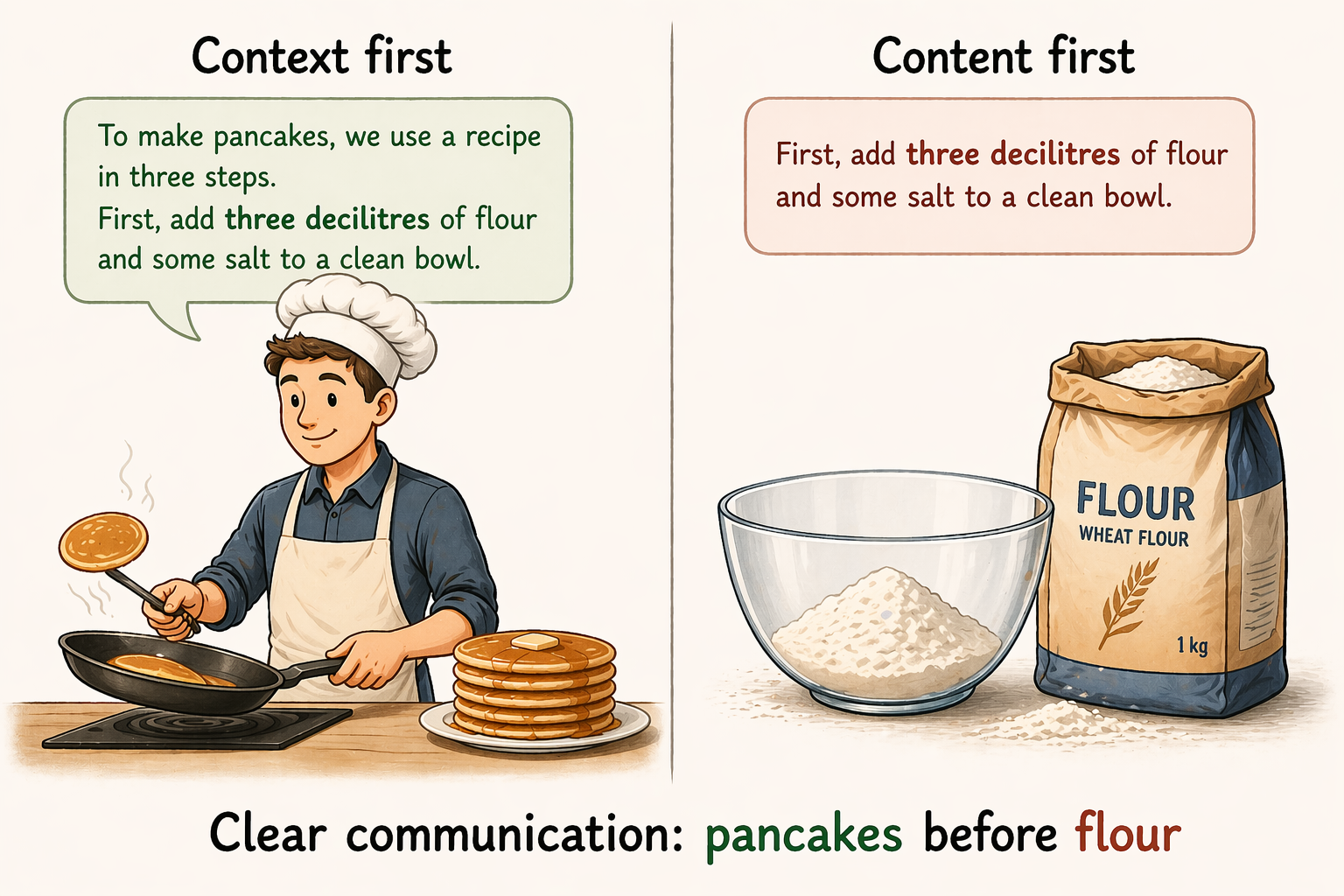
To illustrate this, consider a simple example:
“First, add three decilitres of flour and some salt to a clean bowl.”
On its own, this instruction is ambiguous. It is not clear what is being made, why this step matters, or what will follow.
Now consider the same sentence with context:
“To make pancakes, we use a recipe in three steps. First, add three decilitres of flour and some salt to a clean bowl.”
The content is identical, but the experience of reading it is completely different.
The context provides orientation. It tells the reader what they are doing, why it matters, and what to expect next. Without this, even simple instructions can feel unclear.
This highlights an important point:
The difficulty in writing is often not in the complexity of the ideas, but in the order in which they are presented.
In this sense, writing is almost the opposite of reality.
In reality, we start with ingredients and end with a finished result.
In writing, it is often more effective to begin with the result — or the purpose — and then introduce the details.
👉 In short: clear communication is often “pancakes before flour”.
Over time, I have started trying to reverse my default approach.
Before introducing a concept or result, I try to briefly answer a simple question:
Why should the reader care about this?
Often, a single sentence is enough to provide the necessary context. That small addition gives the reader a place to stand before moving forward into more detailed material.
When this works well, the text tends to feel much easier to follow. The ideas do not change, but the experience of reading them does.
I still forget this principle frequently when writing. But when I remember to apply it, it often makes a noticeable difference.
As with the previous posts, this is not a rule, but simply a reflection that I have found useful in my own work.
PS: The image was generated by AI.
 Johannes G. Borgqvist, PhD
Leave a comment