When I returned to Chalmers from Oxford, I thought I knew exactly what I was going to work on.
My plan was clear: I wanted to continue developing the use of Lie symmetry methods in mathematical biology, a topic that had come to shape much of my research during my years in Oxford. It was intellectually rich, mathematically beautiful, and very close to my heart.
But there is a problem with being too goal-oriented.
In modern academic life, we are often encouraged to think in terms of plans, milestones, and research agendas. This is understandable, of course, but it can also create the illusion that our path is entirely determined by our own intentions. In reality, much of what shapes a scientific career comes from outside ourselves: chance encounters, unexpected ideas, fortunate timing, and opportunities we never planned for.
The Stoics expressed this well in their distinction between what lies within our control and what does not. We can control our effort, our attention, and our willingness to act. But much else — circumstance, timing, and the arrival of new possibilities — lies outside our control. From that perspective, perhaps the task is not to rigidly force a path, but to do one’s best and remain open to what emerges.
Lately, I have found myself thinking about this through the phrase amor fati — love your fate.
For me, this idea has come to life through what I think of as a tale of two newsletters.
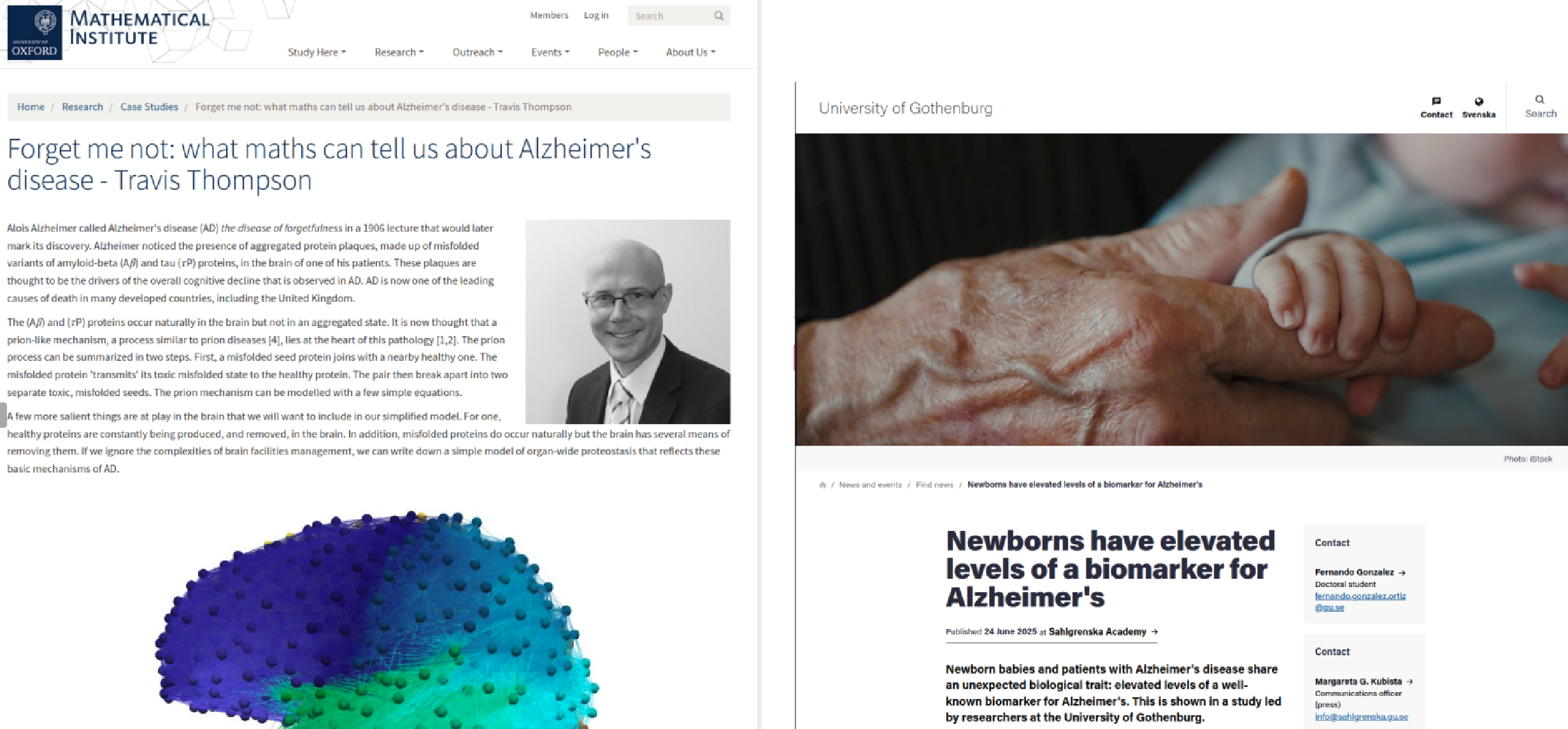
The first arrived while I was still in Oxford.
I was sitting in my office at the Mathematical Institute, with a view of the Radcliffe Observatory, when I received one of those automated newsletters that usually disappear into the background of academic life. This time, for some reason, I opened it.
What I found there caught my attention immediately: a mathematical model based on the prion-like hypothesis for Alzheimer’s disease. I found the idea so fascinating that I could not stop thinking about it.
That moment of curiosity led to a collaboration, and eventually to a paper on prion-like protein dynamics, where we introduced what we called HeMiTo dynamics.
The second newsletter arrived later, after I had returned to Gothenburg.
The office here at Mathematical Sciences does not quite have the same view, but it did come with its own unexpected opportunity. This time, the newsletter came from a world-leading research group at Sahlgrenska Academy, reporting elevated levels of Alzheimer’s disease biomarkers in newborn babies.
As soon as I read it, a new question formed almost immediately:
Could these data be combined with mechanistic models of prion-like proteins in order to improve diagnosis and prognosis in Alzheimer’s disease?
That question led to a new collaboration with Dr Fernando Gonzalez-Ortiz and the group of Professor Henrik Zetterberg. Earlier last week, it also culminated in a research proposal for a starting grant from the Swedish Research Council, with Professor Zetterberg’s group as host institute. The aim is to use mechanistic models of prion-like proteins to predict and forecast the progression of Alzheimer’s disease.
If someone had asked me five months ago what my research direction would be, I would probably have described something much more theoretical and much more closely tied to Lie symmetries. That topic is still very dear to me.
But what has surprised me is that this more applied and clinically relevant direction, which emerged largely through external circumstances, now excites me even more.
That is why I keep coming back to amor fati.
Not as passive resignation, but as an active willingness to make the most of what appears in front of you. To follow curiosity when it unexpectedly shows up in your inbox. To accept that not all of the best research ideas come from long-term planning. And to recognise that sometimes the path you did not set out to take turns out to be the one that matters most.
Research is not always a straight line.
Sometimes, it begins with a newsletter.
 Johannes G. Borgqvist, PhD
Leave a comment